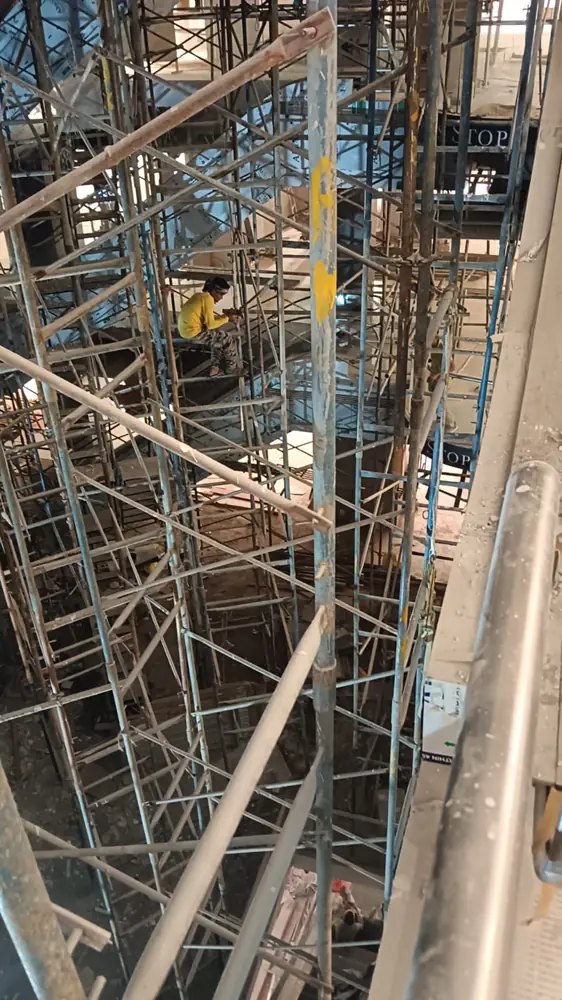
How scaffolding types are classified
Some names refer to a proprietary or modular connection system, while others describe the way a scaffold is supported. For example, Cuplock describes a modular node connection, mobile describes a tower fitted with suitable castors, and suspended describes a platform supported from above.
A project may combine ideas from more than one category. The important decision is not the label but whether the complete arrangement suits the loads, geometry, access, ground and work sequence.
Eight common types of scaffolding
| Type | How it is arranged | Common applications |
|---|---|---|
| H-frame scaffolding | Prefabricated frames connected by braces and platform supports | Repeated façade bays, renovation and general access |
| Cuplock scaffolding | Standards and ledgers lock at modular cup connection points | Construction, industrial access, stairways and layouts needing modular flexibility |
| Tube-and-coupler scaffolding | Individual tubes connected with purpose-made couplers | Irregular shapes and layouts requiring site-specific flexibility |
| Aluminium tower | Lightweight modular tower components | Suitable indoor and outdoor maintenance or installation tasks |
| Mobile scaffolding | A suitable tower or platform structure on lockable castors | Tasks that require repeated repositioning on firm, level surfaces |
| Trestle scaffolding | A low platform supported on trestles or tripods | Limited-height interior work where permitted and properly arranged |
| Cantilever scaffolding | Standards or platforms supported away from the ground by designed needles or brackets | Sites where the ground below cannot support ordinary standards |
| Suspended scaffolding | A platform suspended from roof-level supports using ropes or similar suspension systems | Façade access, inspection and work on tall structures |
Supported, mobile, cantilever and suspended systems
Ground-supported systems transfer most vertical loads to a foundation below the scaffold. Mobile towers also rely on the ground, but their castors and narrow geometry introduce specific stability and movement controls. Cantilever scaffolds transfer loads into a designed supporting structure. Suspended scaffolds hang from roof-level or overhead supports.
Because these load paths are different, changing from one type to another is not a simple material substitution. Support capacity, restraint, access, rescue planning and competent design must be considered.
How to compare scaffold systems
- Required working height and length of the work face
- Available ground area, bearing surface and obstructions
- Workers, tools and material loads expected on each platform
- Need for stairways, ladders, loading bays or multiple levels
- Building shape and positions available for ties or anchors
- Frequency of alteration or relocation during the project
- Exposure to weather, public areas, traffic and electrical hazards
- Availability of compatible components and competent labour
Which scaffolding type should you choose?
Choose only after defining the work. Repetitive façade access may suit H-frames, while a modular Cuplock arrangement may be useful for more varied bay layouts or access structures. A mobile aluminium tower may suit appropriate short-duration work on a firm, level floor. Special cantilever or suspended access needs a specialist assessment.
Preeti Scaffolding can discuss H-frame, MS H-frame, Cuplock, ladders, aluminium access equipment and related labour for Mumbai projects. Final availability and suitability are confirmed for the actual site.