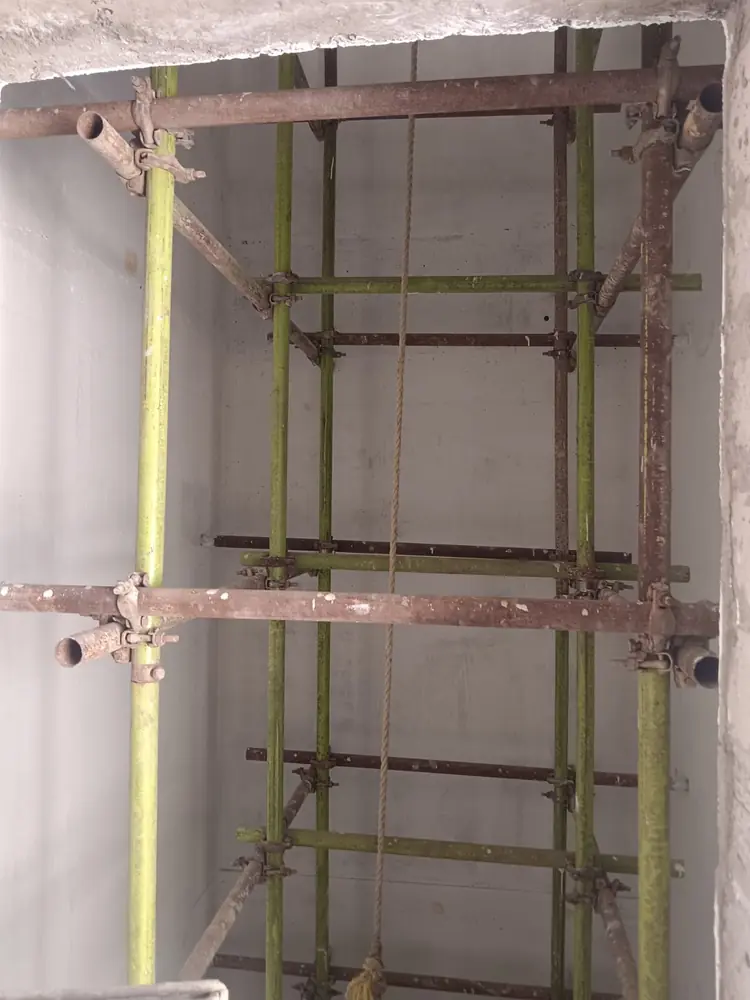
How the Cuplock connection works
Cuplock standards contain fixed lower cups and movable upper cups at regular vertical intervals. Ledger blade ends are positioned in the lower cup, and the upper cup is tightened to secure the connection. The system allows ledgers to connect around the standard at the node.
Correct assembly still depends on compatible components, the manufacturer’s sequence and the planned configuration. A locked node does not by itself confirm that bases, bracing, ties, platforms or loading are correct.
Main Cuplock components
- Vertical standards with cup connection nodes
- Horizontal ledgers sized for the planned bays
- Transoms, intermediate transoms or deck-support members
- Diagonal braces where required by the configuration
- Base plates, base jacks and suitable foundation support
- Platforms, decks, ladders or staircase components
- Ties, anchors, guardrails, toe boards and other protection components
Common Cuplock scaffolding applications
Cuplock systems are used for suitable building construction, façade access, maintenance, industrial access, stairways and multi-level platforms. Their modular nodes can help create repeated bays and changes in direction where the available component sizes fit the project.
Cuplock is also associated with falsework and shoring applications, but access scaffolding and load-support arrangements are different engineering uses. Material should not be reassigned between them without an appropriate design and compatible components.
Benefits and practical limitations
| Potential benefit | Planning point |
|---|---|
| Multiple ledgers can connect at a modular node | Bay dimensions remain governed by available compatible parts |
| Fewer loose fittings at standard-ledger nodes | Cup and blade connections must be clean, undamaged and fully secured |
| Can form platforms, access bays and stairway arrangements | Complex or heavily loaded structures may need specific design |
| Reusable modular components | Mixed or modified components can undermine fit and capacity |
Cuplock versus H-frame scaffolding
Cuplock uses separate vertical standards and horizontal ledgers. H-frame uses prefabricated frames connected into repeated bays. Cuplock may provide more connection directions and bay combinations, while H-frame can be efficient along regular façades.
Compare the complete arrangement, not one component. Access, platforms, ties, braces, foundation, labour sequence and material availability influence the practical choice.
Cuplock scaffolding rental in Mumbai
Preeti Scaffolding supplies Cuplock components, ladders and suitable stairway arrangements on rent or sale for Mumbai projects. Erection and dismantling labour can be discussed with the material requirement.
Send the site location, intended application, working height, approximate plan dimensions, platform levels and project duration. If the scaffold has unusual geometry or duty requirements, flag them at the start of the enquiry.