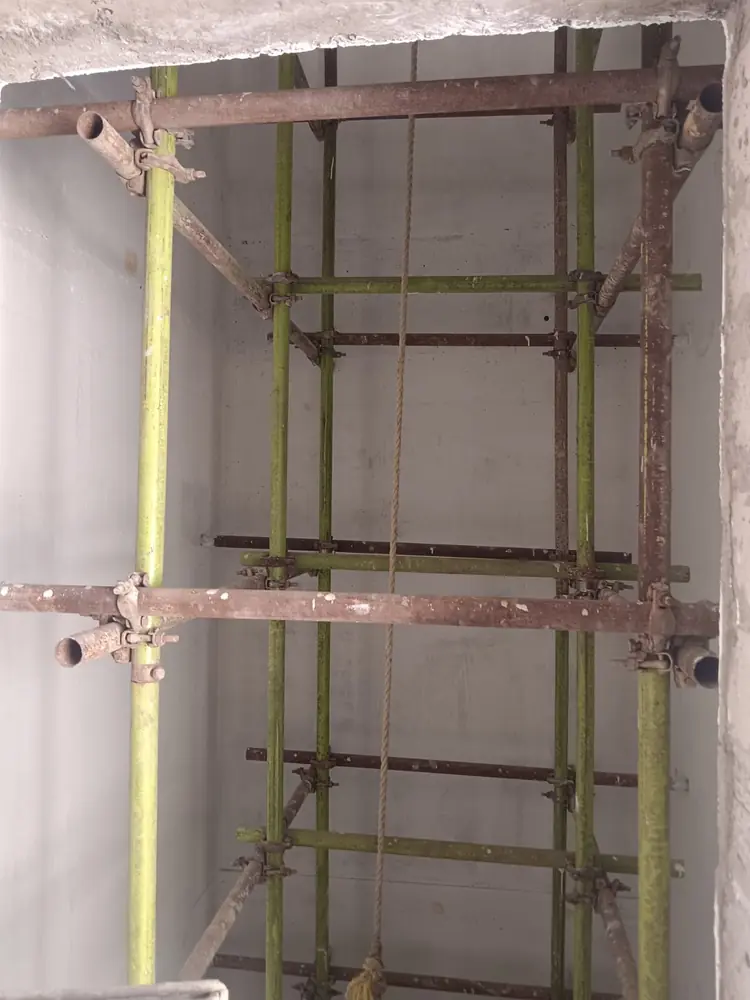
The five functional groups of scaffold parts
| Group | Examples | Function |
|---|---|---|
| Primary structure | Standards, frames and uprights | Carry vertical loads and set the height |
| Horizontal structure | Ledgers, transoms and bearers | Connect bays and support platforms |
| Stability | Braces, ties, anchors and outriggers | Control sway, displacement and overturning |
| Working and access | Decks, platforms, ladders and stairways | Create work surfaces and routes between levels |
| Protection | Guardrails, midrails, toe boards, screens and suitable netting | Help control fall and falling-object risks where specified |
Standards, frames, ledgers and transoms
Standards or uprights are vertical members. In an H-frame system, prefabricated frames combine two uprights with connecting members. Ledgers run horizontally along the scaffold, while transoms or bearers span across the width and may support the platform.
Dimensions, bay spacing and allowable loads depend on the system and configuration. Components should be identified and used according to the manufacturer or approved design rather than selected only by visual similarity.
Base components and adjustable jacks
Base plates distribute the load from standards into a suitable foundation or sole arrangement. Adjustable base jacks may help establish level bearing where allowed by the system. They are not a substitute for weak ground, excessive packing or an unplanned foundation.
The ground or supporting surface must be assessed for the scaffold and the loads expected during use. Drains, basements, voids, slopes and recently filled ground need particular attention.
Braces, ties, anchors and couplers
Braces help the scaffold resist racking and sway. Ties or anchors connect a scaffold to a suitable supporting structure where the configuration requires restraint. Couplers connect tubes or other compatible members and are selected for their intended function.
Removing a brace or tie to make room for work can change stability. Alterations should follow the scaffold plan and be controlled by a competent person; an equivalent restraint may be required before another is removed.
Platforms, access and edge protection
Platforms should be suitable for the scaffold, supported correctly and kept free from gaps or conditions that create avoidable hazards. Ladders and stairways need planned entry and exit points rather than improvised climbing routes.
Guardrails, intermediate protection and toe boards are used according to the work and applicable requirements. Screens, sheeting or netting can introduce additional wind loads, so they should not be attached without considering the scaffold design and ties.
Material compatibility and condition
- Do not force together components from incompatible systems.
- Separate damaged, heavily corroded, bent, cracked or modified parts from usable stock.
- Check locking devices, welds, pins, threads, hooks, decks and access components.
- Store and transport material to reduce impact damage and uncontrolled corrosion.
- Confirm quantities from the approved layout rather than rough area alone.
- Reinspect material when an event could have affected the scaffold.
Scaffolding material supply in Mumbai
Preeti Scaffolding supplies selected H-frame, MS H-frame, Cuplock, ladder and accessory requirements on rent or sale. Share the system, quantity if known, project location, duration and whether erection or dismantling labour is needed.
If you do not have a component list, provide the work-face dimensions and intended use so the requirement can be discussed. Final component quantities should follow the selected configuration and site plan.