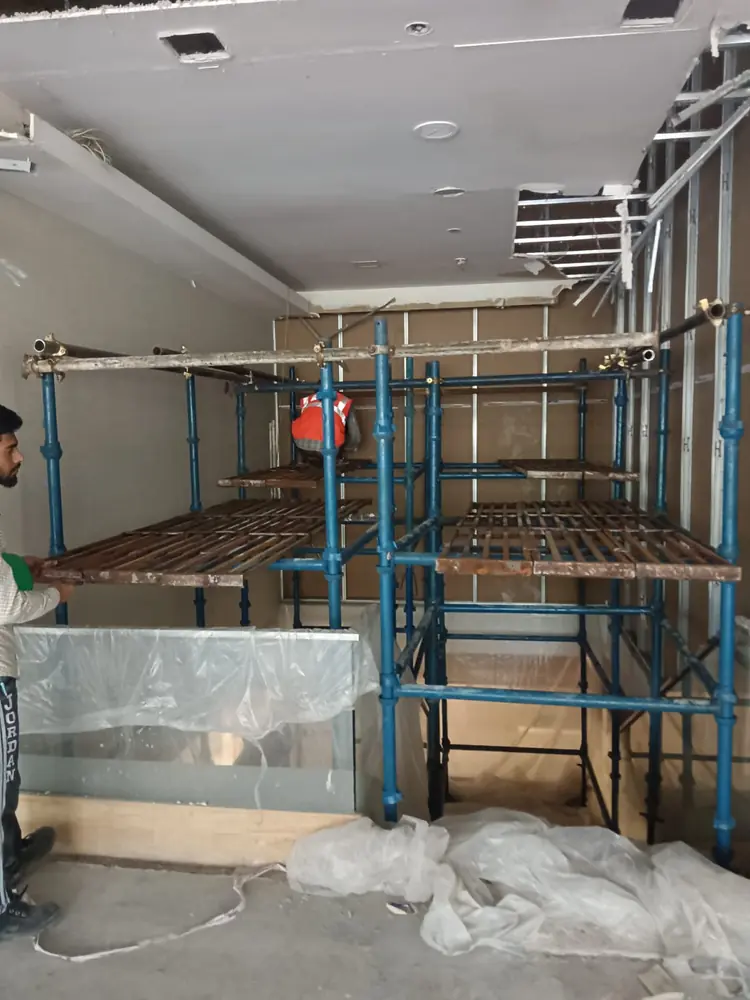
How a mobile scaffold works
The scaffold load travels through frames or standards to castors designed for the tower. Horizontal and diagonal braces maintain geometry, while stabilisers or outriggers widen the effective base where required. Brakes prevent castors from rotating or rolling while the tower is in use.
A tower is only mobile when the complete system has been designed for castor support. Adding wheels to an ordinary scaffold does not create a safe mobile scaffold.
Main components
- Frames or vertical tower members
- Horizontal and diagonal braces
- Purpose-designed castors with effective locking devices
- Platforms, trapdoors and internal access components
- Guardrails, midrails and toe boards
- Stabilisers, outriggers and ballast only where specified by the system
Suitable applications and unsuitable conditions
| Often considered for | Requires another plan or closer assessment |
|---|---|
| Repeated indoor ceiling or service work | Sloping, soft, broken or stepped ground |
| Maintenance along a clear, level work area | Open edges, vehicle routes or uncontrolled public areas |
| Painting or installation at suitable tower heights | Strong wind exposure or large sheeted surfaces |
| Short-duration access with frequent relocation | Heavy materials, long façades or complex multi-level work |
Rules for repositioning a mobile tower
- Follow the system manufacturer’s instructions and the site plan.
- Remove people and unsecured tools or materials before moving unless an approved rule specifically states otherwise.
- Check the route for slopes, holes, debris, overhead obstructions and electrical hazards.
- Release and reapply castor brakes in a controlled sequence.
- Push from a low, suitable point; do not pull from height or use a vehicle.
- Recheck level, stabilisers, braces and castor locks after repositioning.
Mobile scaffold stability
Tower height, base dimensions, outriggers, wind, platform loading and the force applied by workers all influence stability. Never extend the platform height with boxes, ladders or improvised supports.
Doors opening into the tower, moving vehicles, uneven floors and overhead work can introduce additional risks. The area around the tower should be controlled before use.
Choosing mobile scaffolding in Mumbai
When asking about a mobile tower, share the platform height rather than only the ceiling height, the indoor or outdoor location, floor condition, available base area and any narrow doors or passages.
Preeti Scaffolding can review available aluminium access equipment and accessories. If a mobile tower is not suitable, a supported H-frame or Cuplock arrangement may be discussed instead.